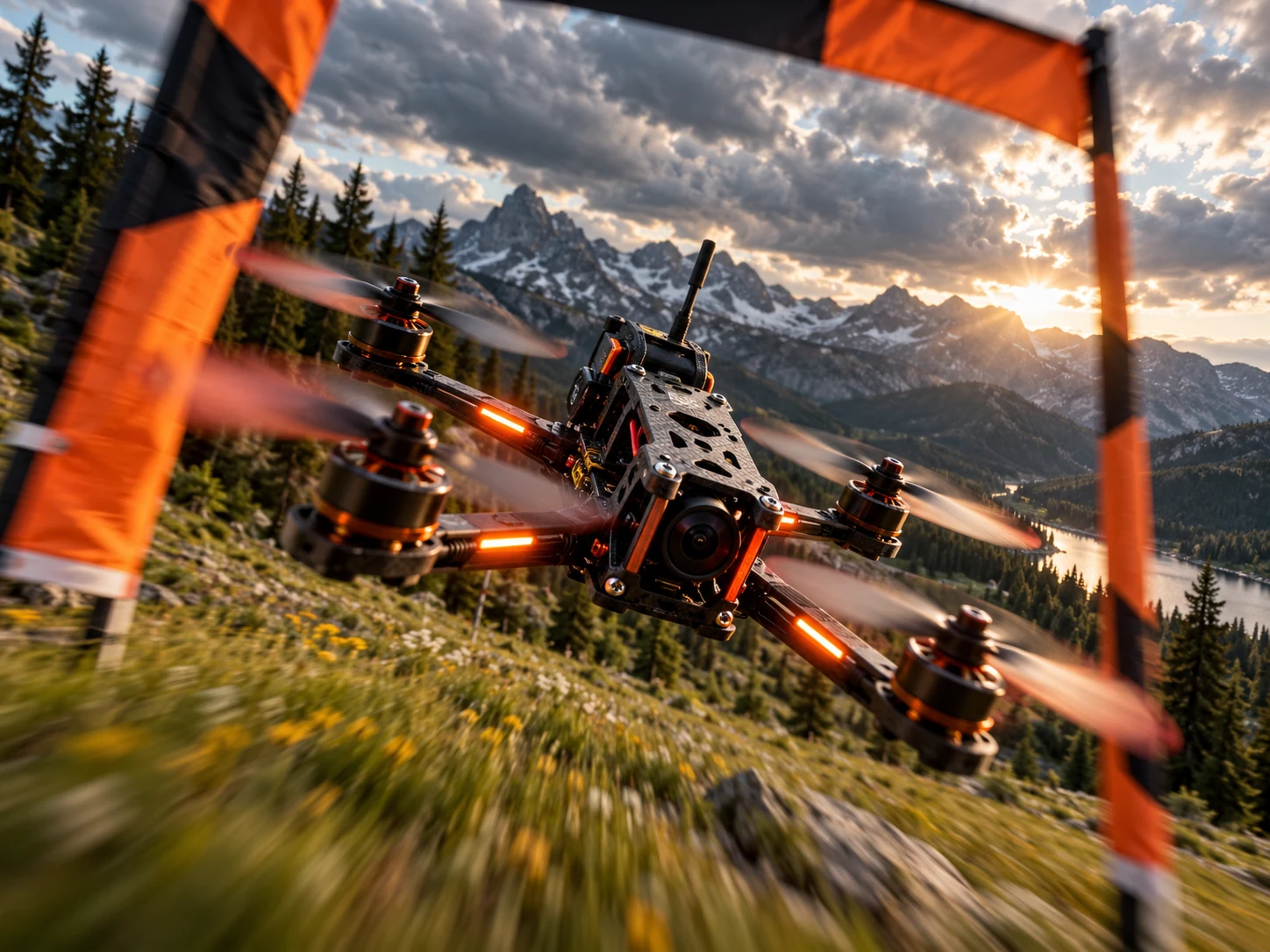

Compare physical FPV competitions and human-piloted drone simulators, including controls, conditions, viewing experiences and rules.
Two types of competition, one important distinction
Physical FPV racing puts actual aircraft on a constructed course. Pilots normally see through live camera feeds while track officials manage a real operating area. Simulator racing places the course and aircraft behavior inside software. Both can involve genuine human skill; neither format should be confused with an automated demonstration or a free prediction game. FAI describes its physical F9U discipline separately from E-Drone Racing, which uses virtual circuits and remote piloting. [F1][F4]
What the pilot controls
In both formats, a person uses control inputs to keep a moving craft on the intended line. A physical pilot must also account for radio links, batteries, propellers, flight hardware and surroundings. A simulator pilot works through compatible computer and controller hardware while navigating the modeled physics and track. The absence of a physical aircraft does not remove decisions about racing lines, timing and momentum. It does, however, change the operational risks and what a technical failure looks like. [F1][F4]
Conditions and consequences
On a real course, weather, visibility, signal quality, aircraft damage and event safety rules may affect the day. Crashes can require repairs or replacement equipment. In a simulator, conditions follow the configured virtual environment and a crash need not destroy physical parts. This makes repeatable practice attractive, but one simulation’s behavior should not be treated as a perfect copy of every real aircraft or venue. The competition operator decides the permitted software, course and controller arrangements for its event. [F2][F4]
The spectator’s view
Physical racing may be watched from a protected public area, a livestream or a combination of ground cameras and FPV feeds. Virtual races commonly emphasize screen capture, timing overlays and online commentary. Both benefit from a clear display of course boundaries, lap progress and standings. If a video shows a brightly rendered virtual course, do not assume a matching outdoor event occurred. Conversely, footage of a real pilot in goggles does not prove the on-screen session is a physical race; captions should establish which format was contested. [F1][F4]
Choose by what you want to learn
A newcomer interested in equipment, venue atmosphere and physical racecraft may prefer outdoor FPV coverage. Someone drawn to accessible practice, repeatable courses and online competition may start with simulated events. For an accurate comparison, inspect the exact event’s documents instead of assuming equal lap counts, brackets or equipment requirements. FAI’s E-Drone World Cup description and MultiGP’s published format examples are useful starting points but refer to different programs. [F4][M1]
Comparison at a glance
The course in physical racing is built in an actual space; the virtual track is represented in software. Physical aircraft can be damaged by contact, whereas simulator losses are modeled rather than repaired with parts. Physical viewing may involve attendance and safety barriers; simulated viewing may rely entirely on captured screens. Both can be organized contests with a human pilot at the controls. Neither should be labeled inherently easier or harder without defining the skill being measured. [F1][F4]
How to label mixed media correctly
A news page may use a real photograph of people wearing goggles next to a simulator screenshot. The combination is visually compelling, but captions must separate the two assets. Identify each with its origin, image type and permissions. If the image is AI-generated, label it as illustrative instead of adding a fictitious event date. The same discipline applies to statistics: a time recorded in a simulator cannot silently become a real-world track record. [F4]
Sources and verification
- [F1] FAI Drone Sports overview — https://www.fai.org/page/drone-sports
- [F4] FAI E-Drone Racing World Cup — https://www.fai.org/edroneracingworldcup
- [F2] FAI Sporting Code 2026 — drone sports — https://www.fai.org/page/documents-and-rules
- [M1] MultiGP International Open 2026 race formats — https://www.multigp.com/io26/race-formats/
Related reading
Editorial scope: This is sports education, not wagering advice. No betting function or live market is offered here.
Sources and further reading
- FAI Drone Sports overview ↗
Consult the original document for the event, class and applicable date.
- FAI Sporting Code 2026 — drone sports ↗
Consult the original document for the event, class and applicable date.
Check the original document for its scope, date and current status.
Something needs a closer look?
Suggest a correction