
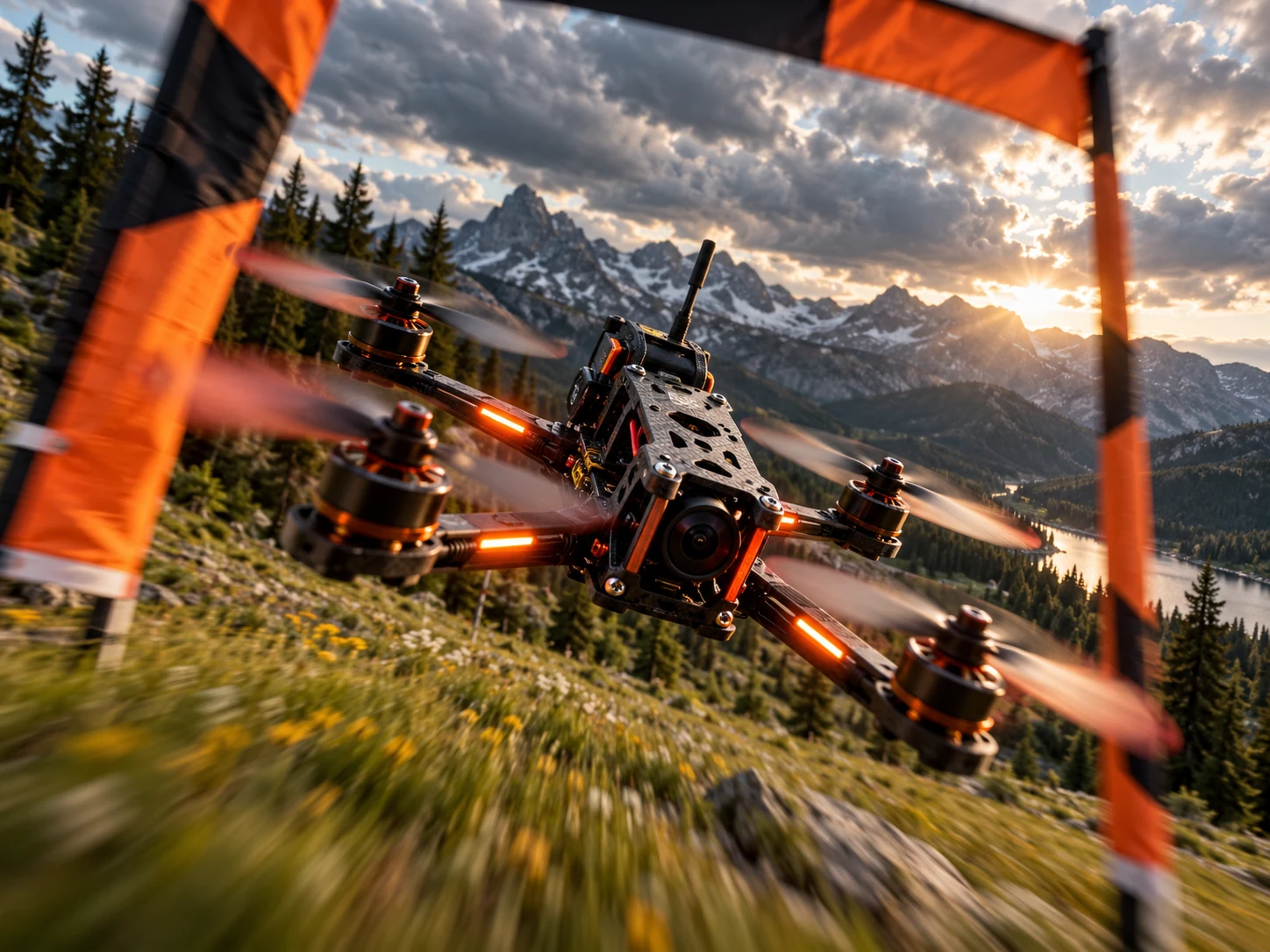
Learn why drone-racing courses use gates, how lap timing works and why a visually fast shortcut may not count.
A racecourse is a sequence, not just a field
Drone racing uses a prescribed path, often marked by gates and obstacles. The course is not simply a collection of objects pilots may pass in any order. The FAI overview describes circuits containing air gates and potentially other obstacles; event rules specify how pilots are expected to navigate them. For spectators, a track map is one of the most useful documents on race day because it turns a blur of motion into a series of decisions. [F1]
What counts as passing a gate
A gate is an identifiable element of the required course. A pilot’s clean racing line combines approach angle, speed and successful passage through the correct opening. At the viewing level, do not assume that moving near a gate is equivalent to completing it. The detailed rulebook defines how passage is judged, how missed elements are handled and whether a correction is possible. Those matters should be attributed to the specific organizer and edition rather than guessed from footage. [F2]
The timing question
A timing system may report a single lap, several consecutive laps or a total race duration. Those are different competitions even when the same course is used. MultiGP IO 2026 provides examples of qualifying based on fastest consecutive laps and race rounds based on completion of a prescribed number of laps. Before sharing a 'fastest time' claim, identify exactly what was timed. A best single lap and the best combined run are not interchangeable statistics. [M1]
Mistakes are part of the race
Pilots may lose time at a tight turn, hesitate to line up a gate or have to recover after contact. A dramatic-looking pass can also be meaningless if the drone has skipped a required feature. Depending on the event rules, an incomplete course may lead to a time penalty, invalid run or another specified consequence. The spectator should use the official classification and written penalty notes where available rather than labeling a flight disqualified on visual impression alone. [F2]
How to use a course graphic
Start with the start/finish location, trace the gate sequence and note where the course changes direction sharply. Next locate the timing line and identify whether the video shows the first lap or a later circuit. Finally check the format: are pilots racing head-to-head, chasing a time or completing a qualifying run? This simple routine works for many races without pretending every event uses the same track dimensions or scoring rules. [F1][M1]
Why one missed gate matters
Consider two pilots with similar pace. One takes a slightly wider line but passes all required elements; the other appears faster but has a disputed course passage. A spectator cannot settle the result by looking at a screenshot. The official rules determine whether the passage counted, whether it must be corrected and how time or penalties affect classification. This makes accuracy part of racecraft rather than an afterthought. [F2]
A better caption for a race graphic
A useful graphic says what session is shown, which lap or attempt the timer represents, and which event supplied the track map. Label a displayed time as provisional if it has not been confirmed by officials. Avoid invented gate counts, fixed track lengths or 'world-record' language without a source. Good visual explanation is a combination of legible labels and careful claims, not a flood of numbers. [F1][M1]
Sources and verification
- [F1] FAI Drone Sports overview — https://www.fai.org/page/drone-sports
- [F2] FAI Sporting Code 2026 — drone sports — https://www.fai.org/page/documents-and-rules
- [M1] MultiGP International Open 2026 race formats — https://www.multigp.com/io26/race-formats/
Related reading
Editorial scope: This is sports education, not wagering advice. No betting function or live market is offered here.
Sources and further reading
- FAI Drone Sports overview ↗
Consult the original document for the event, class and applicable date.
- FAI Sporting Code 2026 — drone sports ↗
Consult the original document for the event, class and applicable date.
Check the original document for its scope, date and current status.
Something needs a closer look?
Suggest a correction